As the world struggles to reopen and establish a new post coronavirus normal, cross-border travel will likely be the last activity to go back to life as usual. Almost every country and territory around the world have imposed relevant travel restrictions. In many places, particularly in China where the virus outbraeke first, travelers from overseas have to quarantine for 14 days to ensure they are free of the virus.
The virus has been raging overseas and became a global pandemic, while the epidemic spread in China has been slowing. The situation in most of the cities in China is being put under control and the Chinese government takes novel coronavirus as a grave threat now. Under this circumstance, Mainland Chinese government has established strict cross-border travel restrictions.
Imported infections of novel coronavirus have also been seen as a threat to the Shenzhen government with the increasing number of confirmed cases in Hong Kong. To prevent the virus from staging a comeback, the Shenzhen government has tightened its control at customs in February. Before the 14 days quarantine rule being effective in Shenzhen, a large number of international arrivals chose Hong Kong as a transit spot to mainland China.
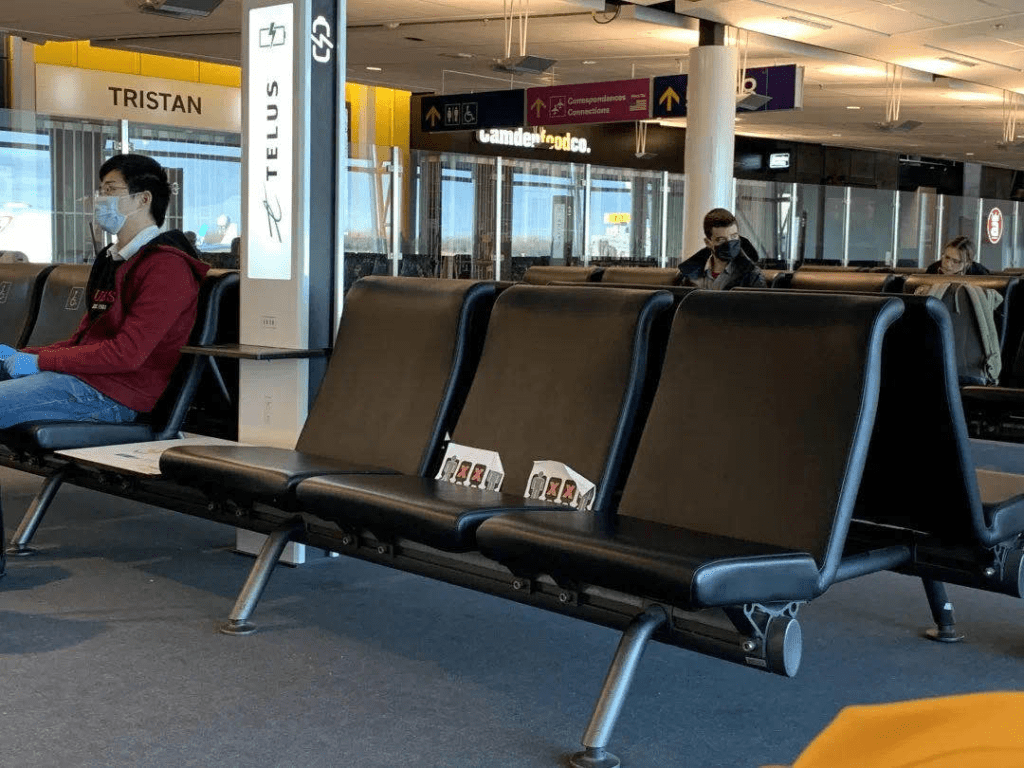
The 14 days quarantine rule for arrivals from Hong Kong to Shenzhen has come to effective since March 28th. Only Shenzhen bay port is available among the six ports for travelers now to directly enter Shenzhen and every traveler who leaves Hong Kong for Shenzhen must take a nucleic acid test and complete 14 days quarantine at the designed hotel in Shenzhen.
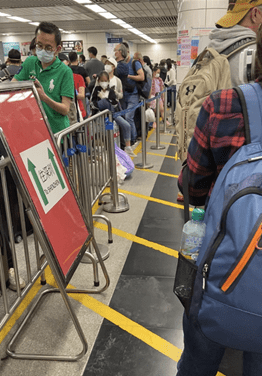
“Shenzhen is like the Chinese mainland’s south gate to prevent imported cases from reaching Guangdong Province and the whole country,” says Feng Taozhu, an associate professor at Xi’an Jiaotong University.
For those who left Hong Kong for mainland China before the 14 days quarantine rules being effective, they have to take a nucleic acid test at the Shenzhen bay port, and the result of the nucleic acid test will be available within 24 hours. Infected people will receive a phone notification and accept further treatments in isolation. As for healthy travelers, they can move freely in Shenzhen and go to other cities in the mainland.
However, they still have to obey the different quarantine rules according to local government in the mainland. “I have taken the nucleic acid test in Shenzhen bay port on March 22nd, the first day that the Shenzhen port starts to take a nucleic acid test for the travelers from Hong Kong to Shenzhen. Because there were no quarantine rules for Hong Kong at that time, I can directly go the Shenzhen airport after crossing Shenzhen bay port and take the flight to Chengdu,” says Congaly, the student from the Chinese University of Hong Kong.
After returning to Chengdu, Congaly completed the 14 days quarantine in the hotel and took the nucleic acid test twice in Chengdu. “What drives me crazy is that after the 14 days quarantine in the hotel, the government still requires me to stay at home for another seven days and report my temperature twice a day to the community hospital,” says Congaly.
According to Congaly, even in the same city, different districts have their own quarantine rules. “Some districts don’t ask another seven days self-quarantine at home while the district where I live requires additional one-week quarantine at home. I have no alternative but to obey the rule because my health code is yellow and can’t enter the community unless my code becomes green after additional self-quarantine at home,” he says.
Health code is now widely used in mainland China. It is almost a necessity for people to take public transportation, enter the community and do other daily activities. People are required to register the health code through their phones and report their travel history online. The code will automatically appear in different colors according to individual travel history.
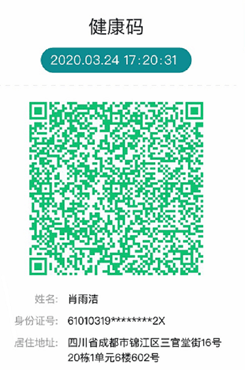
Within the 14-days, if the individual has traveled in high-risk countries and territories, the code will appear in yellow, which suggests that they can not freely enter the places require to check the code. For those who don’t have travel history in high-risk areas, their code will be green. Hong Kong has been regarded as a high-risk area by the Chinese government since February.
However, after the Shenzhen government established 14 days quarantine rules for the travelers leave from Hong Kong to Shenzhen, travelers must complete 14 days quarantine in the designed hotels in Shenzhen even they have residential places or have other destinations in other mainland cities.
“The total expense of 14 days quarantine in Shenzhen is not cheap. The 14 days room fare in total is 3612RMB, and meal fees are 1400RMB. The hotel will charge the total quarantine fees in total, which is 5012RMB.,” says Jia Sicheng, the final year student from the University of Hong Kong who left Hong Kong for Chongqing.
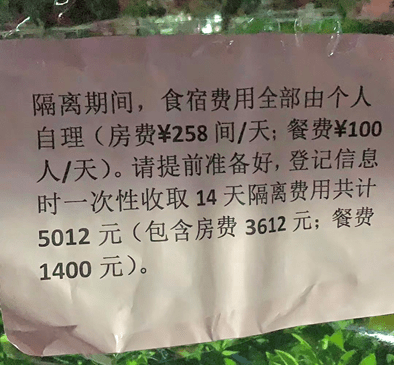
According to Sicheng, he took the nucleic acid test and completed 14 days quarantine in Shenzhen hotels before returning to Chongqing. “During my quarantine periods, I received six phone calls from Chongqing epidemic prevention department, local police station and my community hospitals to ask my travel history, which is kind of annoying,” says Sicheng. “But I don’t need any quarantine after returning home,” he adds.
People who arrived in Hong Kong from overseas and still need to go to mainland China have to take a nucleic acid test and complete 14 days quarantine in Hong Kong, whether at hotels or in their residential places. After 14 days of quarantine over, they are free to continue freely travel to other cities in the mainland while they have to present their quarantine certificate to the local mainland authorities to avoid other quarantine requirements.
It is not clear how long the quarantine policy will last for travelers from Hong Kong to mainland China. “As the summer holiday is approaching, the overseas students who are returning from foreign countries to mainland China will be a major concern for the Chinese government to control the virus. As an important transit point for international flights, Hong Kong is still vital to prevent imported cases from overseas,” says Professor Feng.






 Rita's World